
Client
An investment group engaged us to conduct commercial due diligence on a Kuwait-based logistics company serving industrial, retail, and distribution customers. The target operated warehousing and transport activities and had developed a portfolio of recurring B2B clients across several sectors.
Issues
The investment case assumed strong revenue growth, improving warehouse utilization, increased customer retention, and expansion into higher-value logistics services.
Management required independent validation of market demand, customer concentration, pricing sustainability, competitive position, operating capacity, and future growth potential.
Solution
We conducted a commercial due diligence covering market attractiveness, customer analysis, competitor benchmarking, service economics, capacity utilization, and growth opportunities.
Approach
We analysed the target’s customer base, revenue mix, contract structure, and service portfolio alongside market demand across industrial, retail, distribution, and e-commerce customers.
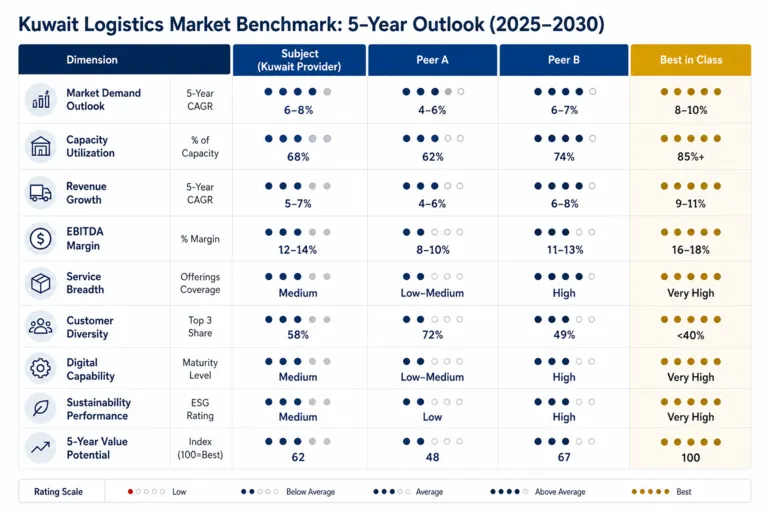
Competitors were benchmarked across warehousing capacity, pricing, transport capability, technology, customer relationships, and service differentiation.
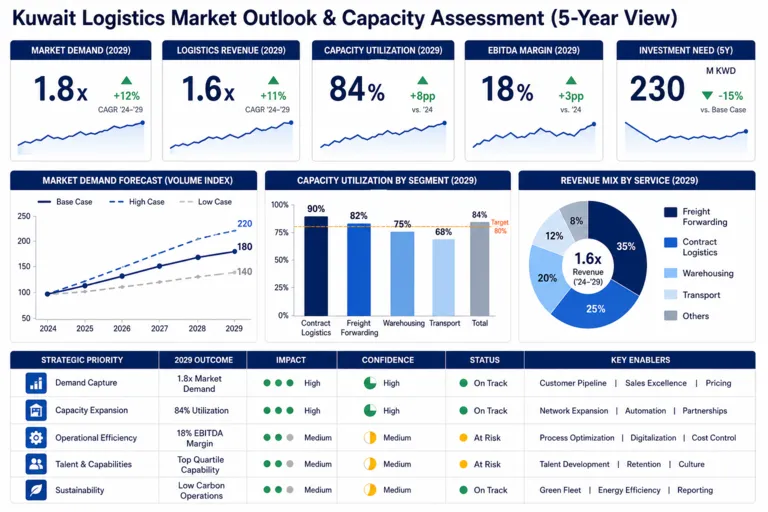
Management forecasts were then tested against customer retention patterns, market conditions, current utilization, and realistic expansion potential.
Recommendations
We recommended proceeding with the transaction while revising the original investment case.
The base case placed greater emphasis on customer retention, warehouse productivity, and selected value-added services rather than assuming rapid volume expansion.
Future capacity investment was also linked to utilization thresholds rather than management’s original growth forecast.
Engagement ROI
The diligence led the investor to revise the target’s five-year base-case revenue growth assumption from approximately 10% to 7.5% annually, creating a more disciplined basis for the investment case. The updated commercial assessment supported a 5–7% adjustment to the proposed valuation and identified three operational and commercial initiatives with modeled potential to improve EBITDA margin by approximately 1–1.5 percentage points over three years.