
Client
An industrial automation company engaged us to evaluate Kuwait as part of its wider GCC expansion. The business supplied control systems, monitoring solutions, and automation technologies for industrial and infrastructure applications. The client wanted to understand demand across energy, utilities, manufacturing, and infrastructure customers and determine whether Kuwait justified a dedicated commercial presence.
Issues
Management had limited visibility on the size of the addressable market and the purchasing structures used by major industrial customers.
The company also needed to understand whether opportunities were concentrated among a small number of large accounts, how established competitors were positioned, and whether direct sales, a technical distributor, or a local systems-integration partner would provide the strongest route to market.
Solution
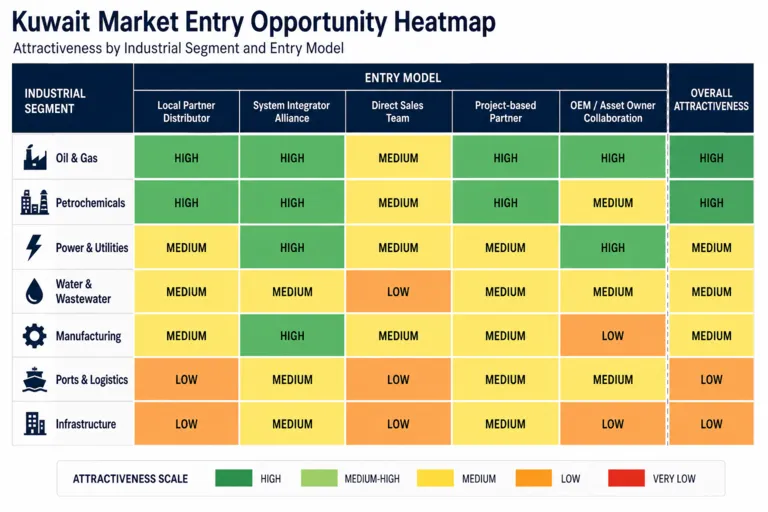
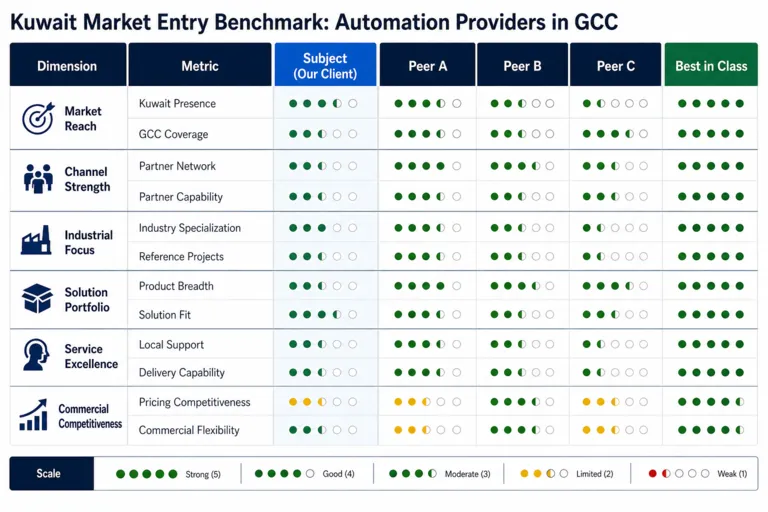
We developed a Kuwait market entry strategy combining demand assessment, customer segmentation, competitor benchmarking, channel analysis, and partner screening.
Approach
We mapped potential demand across energy, utilities, industrial facilities, infrastructure operators, and engineering contractors.
Priority accounts were assessed according to project activity, existing automation infrastructure, procurement model, technology requirements, and potential need for modernization.
Competitors and local partners were benchmarked on technical capability, installed base, customer relationships, after-sales support, and sector coverage.
Recommendations
We recommended a partner-led entry model supported by direct technical engagement with selected strategic accounts.
Rather than building a full local organization immediately, the client would initially focus on a defined group of high-value customers supported by one technical integration partner with established engineering and service capabilities.
Engagement ROI
The engagement reduced an initial universe of more than 80 potential accounts to 21 priority customers and identified four qualified local partners for further evaluation. Based on the recommended partner-led entry model, first-phase market-entry costs were estimated to be approximately 12–15% lower than under the client’s original direct-entry plan, while maintaining access to the highest-priority industrial accounts.